

University Indoctrination Centers Are Being Abandoned
Up to 25% of U.S. colleges may close soon, largely due to their inferior product.

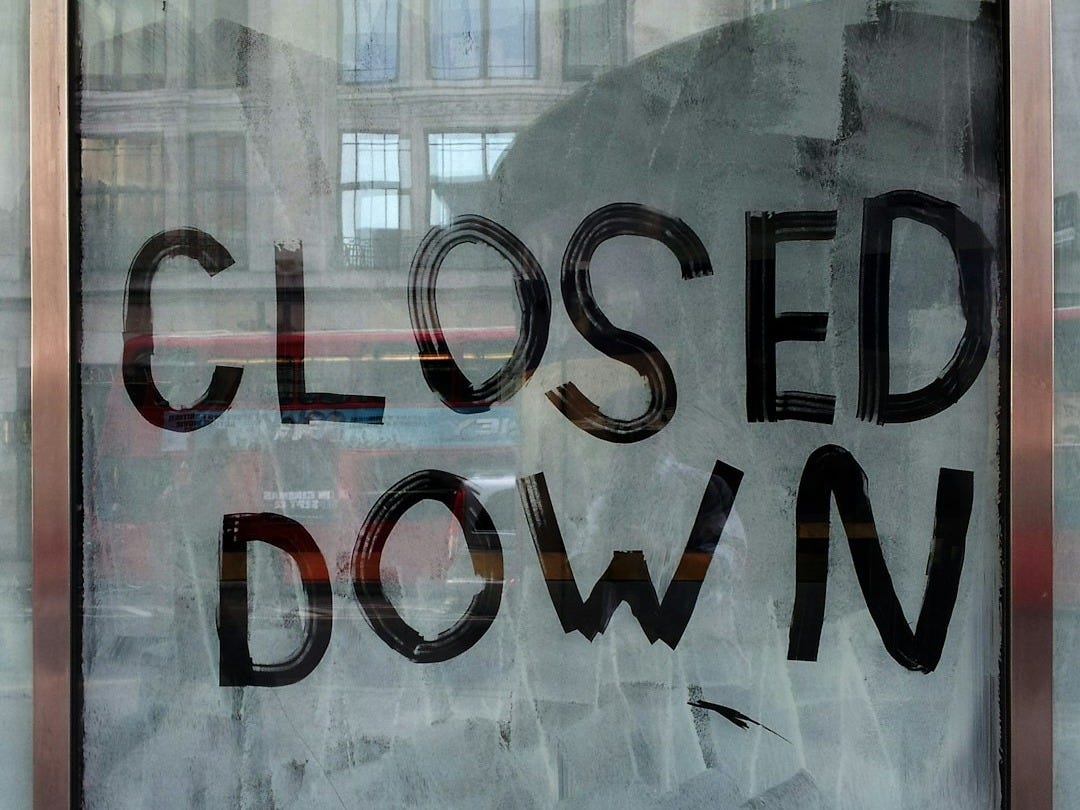
As I wrote last week, public schools are depopulating on a large scale for a variety of reasons, including a declining birth rate, the fact that many of them don’t offer a worthy product, the advancement of school choice, and others. Colleges are faring even worse for many of the same reasons. In January, Arthur Levine, president of Brandeis University, asserted that 20% to 25% of colleges will close in the coming years.
Similarly, the Hechinger Report projects that 442 of the nation’s 1,700 private, nonprofit four-year colleges and universities, representing 670,000 students, are at risk of closing or merging over the next 10 years. More than 120 institutions are at high risk, according to Huron Consulting Group, which analyzed enrollment trends and related metrics.
The American people understand the problems with our universities.
The share of Americans who believe a college degree pays off has fallen 20 percentage points since 2013. Today, 63% say it’s “not worth the cost because people often graduate without specific job skills and with a large amount of debt to pay off,” according to an NBC poll. Only 46% of those with college degrees believe they are worth the cost, a 17-point drop. In fact, inflation-adjusted tuition has roughly doubled at public and private colleges over the past 30 years.
Parents are also getting the message, as college degrees are less of a priority for them. Only 28% of parents now believe a four-year college degree is important for young people pursuing a career.
Parental buy-in is essential because a college education is one of the largest investments a family will ever make, and it must deliver a clear return. Traditionally, our colleges and universities have helped graduates secure jobs, pursue meaningful work, and contribute to their communities, but that is no longer true.
In reality, we may be returning to where we were in 1960, when only 7.7% of adult Americans held college degrees. The share has since risen to 38.3%.
In 2017, economist and academic Walter Williams reported that one in three college graduates held a job historically performed by those with a high school diploma or its equivalent. Williams, citing Ohio University economics professor Richard Vedder, wrote that the U.S. was home to “115,000 janitors, 16,000 parking lot attendants, 83,000 bartenders and about 35,000 taxi drivers with bachelor’s degrees in 2012.”
Also, regarding jobs, recent data from the New York Federal Reserve Bank show that unemployment among college graduates ages 22 to 27 rose to 5.6% in December, roughly the same as in February 2009 during the financial panic. Unemployment among young college grads is now about 1.4 percentage points higher than among all workers.
Why, specifically, are so many universities going down the tubes?
A new report from Yale University sheds light on the decline in public trust in higher education and on the responsibility universities must assume for what’s happened. In recent years, antisemitism, the erosion of free speech rights, and ideological conformity have become the norm at Yale and many of our leading educational institutions.
The Yale committee also reviewed a 2025 Pew Research Center survey, which found that 70% of Americans believe higher education is headed in the wrong direction. Additionally, the report cites a Gallup poll showing how sharply trust in higher education has fallen over the past 10 years.
American Enterprise Institute research fellow Daniel Buck and Garion Frankel of the James G. Martin Center give examples of the avalanche of radical political and cultural drivel that is omnipresent on campuses today. Oregon State University offers “Disney: Gender, Race, and Empire.” Students at Indiana University can take “Having it All: Postfeminist Media After Sex and the City.”
They continue, “How about ‘Bad Bunny: Musical Aesthetics and Politics’ at Yale University? The Bad Bunny Syllabus that inspired this course—which lists topics such as ‘LGBTQ Activism,’ ‘Gender and Sexuality in Reggaeton,’ and ‘Political Protests of Summer 2019’ for study—is also used at Wellesley College and Loyola Marymount University. Both Swarthmore College and the University of Chicago offer courses on ‘Queering God.’”
Not surprisingly, California is a leading state in the downward trajectory of higher education, and California State University, Northridge, offers a prime example. The school offers “healing spaces” for students to engage in “conversations regarding race, anti-racism, diversity, equity, and inclusivity.” CSUN also has a resource center for “lesbian, gay, bisexual, transgender, queer, questioning, intersex, and asexual (LGBTQIA+) students.”
To expand students’ understanding of diversity, CSUN maintains an “anti-racism resource list” that includes “allyship articles,” unconscious bias training, and law-enforcement alternatives, all intended to encourage students to challenge authority in the name of revolution and justice.
While CSUN ranks first in the western U.S. for diversity, it has a pathetic four-year graduation rate of 17% and a six-year graduation rate of 54%.
What does the future hold?
Going forward, higher education must abandon its role as a purveyor of radical political and cultural indoctrination and return to its core mission of fostering critical thinking, intellectual exploration, and professional skills.
There must also be genuine diversity of ideas within our universities. Research funding, faculty hiring, and academic recognition should be grounded in scholarly excellence rather than ideological litmus tests.
Until things change, high school graduates can join apprenticeship programs that provide paid training in trades such as carpentry, plumbing, and bricklaying, taught by skilled industry professionals and often leading to a job afterward. A case in point is California, where the Department of Industrial Relations offers apprenticeship programs in various building trades. It also offers training for careers in healthcare, technology, transportation, and firefighting, among others.
Ultimately, students and their parents need to reconsider whether a college degree is desirable. Unless a student is pursuing a career that requires higher education, such as becoming a lawyer or a doctor, it would be better for them, their families, and taxpayers to skip college altogether and explore other options that allow them to acquire skills that enrich their lives and help them become productive members of society, rather than becoming unskilled, brainwashed left-wing automatons.
* * *
Larry Sand is a retired classroom teacher with 28 years of experience and served as president of the nonprofit California Teachers Empowerment Network from 2006 to 2025. He currently works to raise awareness of the shortcomings of our education system.
Click HERE to visit our new and improved official website on how to leave your union and for different education options!
 | A guest post by
|