

Escaping The Educational Industrial Complex
It’s time for parents to take full control of their children’s education.

The recently released EdChoice “Schooling in America” survey finds that 56% of parents believe K-12 education is on the wrong track. Indeed, too many traditional American public schools are failing to fulfill their role.
Parental unhappiness is certainly understandable, given that the National Assessment of Educational Progress (NAEP), aka the “Nation’s Report Card,” showed that in 2024, 12th-grade students scored their lowest in reading and math in decades.
In math, 45% of high school seniors scored “below basic,” the lowest level since 2005. In reading, 32% scored “below basic,” the lowest level since the exam’s inception in 1992.
Among 8th-graders, 38% scored “below basic” in science, meaning they couldn’t recognize basic facts, such as the fact that plants need sunlight to grow.
At the same time that test scores are sinking, many teachers spend valuable class time exploring wokeism and related nonsense, and teachers’ unions refuse to allow bad teachers to be fired. The question then becomes what a parent should do to address this untenable problem.
If a school choice program or an effective charter school exists, a parent can send their children there. However, what if no choice options are available?
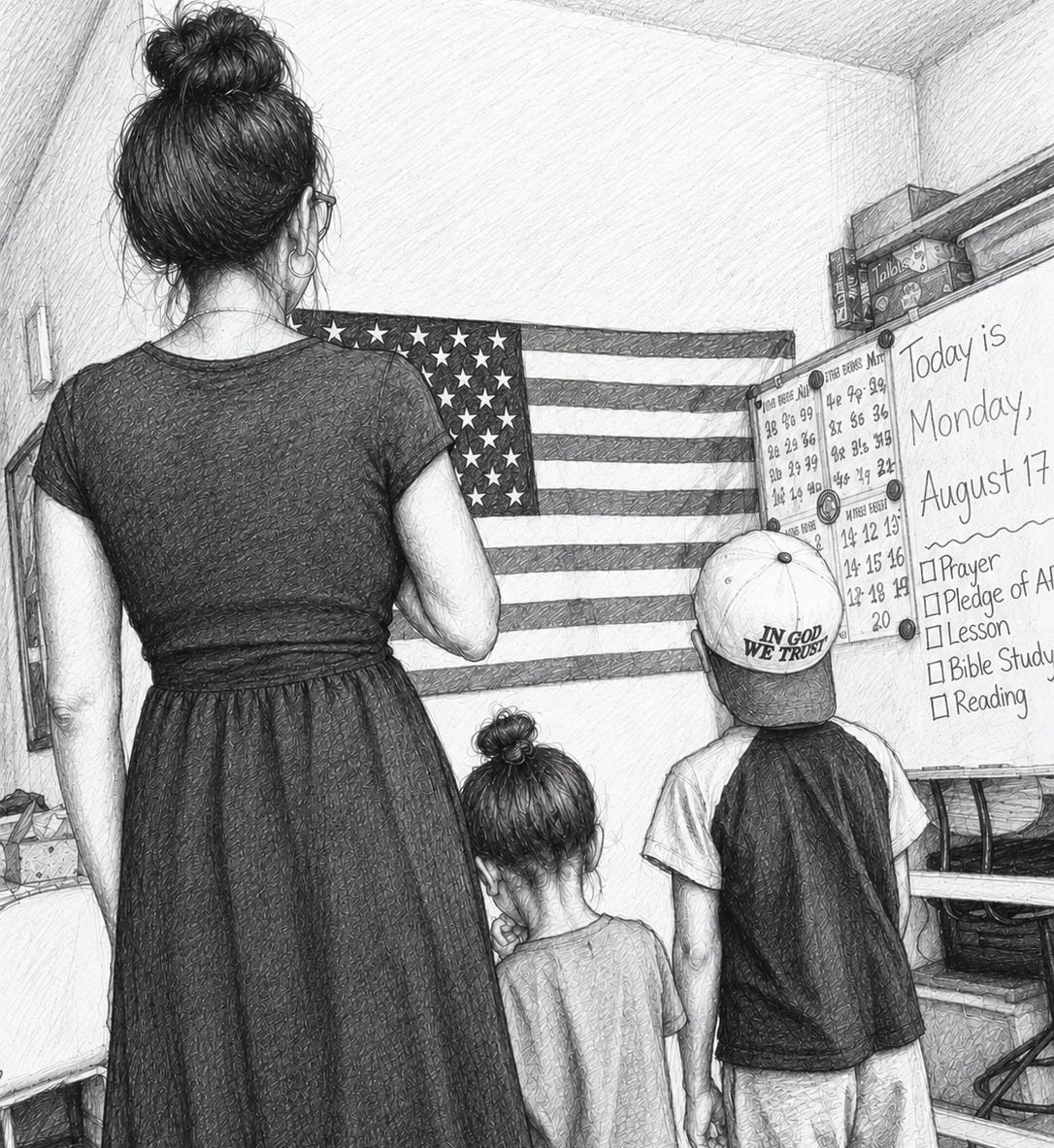
The answer is to take full control of your child’s education. While this may give many parents pause, homeschooling is a deeply American tradition. Contrary to stereotypes, it is no longer a niche practice but an accessible, effective, and reasonable option for parents seeking greater control over their children’s instruction.
In a recent poll, homeschooling parents cited several key reasons for taking things into their own hands. They were asked to “Please rate how much you agree that the following are important reasons for why you homeschool.” Some 62% of families rated “You want to emphasize family life together” or “You prefer to teach at home so that you can provide moral instruction” as “extremely important.” “Because the child has special needs (e.g., physical or mental health) that the schools can’t or won’t address” was rated as quite or extremely important by 19% of parents. Also, 13% said that “Inability to regularly attend school due to COVID exposures/policies” was quite or extremely important.
The National Home Education Research Institute reports that about 3.41 million students in grades K-12 were homeschooled in the U.S. during the 2024-2025 school year, up from 2.5 million in spring 2019. It is now estimated that 6.3% of the school-age population is educated at home. Homeschooling has been growing by an estimated 2% to 8% annually.
Importantly, parents today have access to a variety of resources that were not available in the past. According to a nationally representative survey by the RAND American Life Panel, 88% of homeschooling parents use some form of additional support—more than 40% use online resources, including YouTube videos and online curricula. Nearly a quarter enroll their child in an online school, and 10% hire a tutor.
Students educated at home perform considerably better than those educated in conventional schools. A recent nationwide study shows that homeschooled students score well above the national average in reading, language, math, social studies, and science.
Clearly, a boon to the homeschool movement was the teacher-union-orchestrated COVID lockdowns that shuttered most of the country’s public schools for a year or more and forced online learning, which was a disaster on many counts, but there was a silver lining. Parents saw exactly what teachers were teaching and how they were teaching it, and many were not pleased.
The shutdowns backfired on the teachers’ unions, which cannot tolerate homeschooling. Before COVID, homeschooling wasn’t a big enough issue for the unions to bother with, but now they have become more aggressive.
This is epitomized by the teachers’ union in San Francisco, which went on strike for four days in February. The United Educators of San Francisco didn’t just walk off the job; they emailed parents, urging them to avoid at-home learning. They did so because any educational progress families made independently would weaken the union’s bargaining position. This move highlights the clash between powerful teachers’ unions and fundamental parental rights.
The pandemic closures also led to a form of homeschooling called microschooling. In this arrangement, schools are typically very small and include students of varying ages. These schools have schedules and curricula tailored to each class’s needs. They are growing in popularity and currently educate about 2% of the U.S. student population—roughly a million students. Most microschools are run by parents, though some are part of a formal network that provides paid, in-person teachers. Lessons take place in various settings, including homes, libraries, and community centers.
Microschools today are less “micro” than they used to be, according to the latest analysis of the sector from the National Microschooling Center. In 2024, the median number of students in a typical microschool was 16. That figure has since risen to 22, reflecting school operators’ growing experience, reports Don Soifer, the center’s CEO. However, some now serve as many as 100 students.
Microschools use a range of funding models. Most respondents in the National Microschooling Center poll (63%) said they rely on tuition-based funding, and a majority of families pay most of their child’s tuition. Half of the surveyed schools reported receiving funding from state-provided school choice programs, such as education savings accounts and taxpayer-funded scholarships.
A 2025 report by the Rand Corp. found that the median monthly fee for microschools in 2023 was $650, or about $6,500 for a typical 10-month school year.
As with homeschooling, microschools are in the crosshairs of the left. A typical example is the Center for American Progress, which raised accountability concerns about microschools and recommended that policymakers take steps to curtail them. Suggestions included adopting a federal definition of microschools, implementing state-level accountability measures, establishing data collection and reporting standards, and protecting students’ civil rights.
Ultimately, parents should take charge of their children’s education, just as they feed, clothe, and house them. The education establishment and the teachers’ unions have their own agenda, and effective teaching isn’t a top priority.
* * *
Larry Sand is a retired classroom teacher with 28 years of experience and served as president of the nonprofit California Teachers Empowerment Network from 2006 to 2025. He currently works to raise awareness of the shortcomings of our education system.
Click HERE to visit our new and improved official website on how to leave your union and for different education options!
 | A guest post by
|